Dog Bite
An encounter with an aggressive or unpredictable dog can happen anywhere-on the street, in the neighborhood, near dump sites, on a country road, in a park, around construction sites, or while walking outside the city. In most cases, people hope that such a situation will pass without incident, but when the animal approaches persistently, barks, circles, growls, or attempts to attack, there is little time to react. The topic of dog bites should not be viewed solely as a medical issue after the incident, but also as a matter of prevention, proper behavior, and personal preparedness.
When a person thinks about the risk in advance, the chance of avoiding an incident is greater. This is where the dog lead comes in as a practical tool for maintaining distance and deterring an approaching dog without resorting to physical contact. A well-chosen dog repellent is not a tool for confrontation, but a preventive measure that can provide time, space, and peace of mind in a tense moment. If carried correctly and kept within reach, it is often more useful before contact occurs, rather than after.
Here you’ll learn what to do if you’re at risk of a dog bite, how to respond after an incident, which symptoms are cause for concern, when medical attention is needed, and why the dog repellent deserves a prominent place in the personal gear of people who frequently walk, bike, run, work outdoors, or visit areas with stray dogs.
Why the Risk Should Not Be Underestimated
In public discourse, the issue is often downplayed with the notion that “the dog is just barking” or that “if you don’t provoke it, nothing will happen”. In reality, a dog’s behavior depends on a number of factors-territoriality, food guarding, fear, pain, stress, past experiences, perception of a threat, or the habit of chasing moving people and bicycles. The American Veterinary Medical Association emphasizes that any dog can bite; its history and behavior are the deciding factors, not simply breed, size, or age.
In addition to the injury itself, a dog bite carries a risk of infection. The NHS notes that animal bites may require medical evaluation, especially if the wound is deep, if a hand, foot, or face is affected, if there is heavy bleeding, or if signs of infection appear. The CDC and WHO also emphasize the importance of screening for rabies and tetanus, because in some circumstances, emergency prophylaxis is needed after a bite.
That is why it is wiser to focus on prevention rather than assuming that “it won’t happen”. For people who frequently walk at night, in outlying areas, in industrial zones, on unpaved roads, or near yards with dogs, being prepared is not an unnecessary precaution, but common sense. In this context, a dog repellent is a logical choice because it supports prevention rather than a reaction after the fact.
What Behavior Increases the Risk
One of the most common mistakes is panicking. When a dog approaches suddenly, the first reaction is often to run away, scream, or wave one’s arms wildly. According to the CDC and the AVMA, this is exactly what can make the situation worse. When encountering an unfamiliar and threatening dog, it is recommended that a person remain calm, do not run, do not scream, and avoid direct eye contact. If possible, you should back away slowly, without turning your back and without making any sudden movements.
These recommendations are important, but in a real-life situation, they are not always sufficient. If the dog continues to close the distance, if there is more than one dog, if the person is alone, if there is no barrier nearby, or if the animal is already showing signs of readiness to attack, simply remaining calm may not solve the problem. This is precisely where the dog repellent has great practical value-as a tool to help you stop the dog from approaching before contact is even made.
Why a Dog repellent Is a Sensible Choice
When it comes to preventing dog bites, the dog repellent should be viewed as a means of early intervention. Its greatest strength is that it works before a physical confrontation occurs. Instead of waiting for the animal to get dangerously close, surround you, or jump at you, the idea is to create distance in time and give yourself a chance to retreat safely. This is very important for people who are out and about alone, as well as for runners, cyclists, couriers, hikers, and residents of areas where encounters with stray dogs are common.
It’s best not to keep the dog repellent buried deep in a backpack, but rather in a place where it’s easily accessible-in a pocket, on a belt, in a side pouch, or in a compartment that opens immediately. There’s little use for a device that’s “somewhere in your luggage” if you can’t get it out in time when you actually need it. It’s just as important to keep the device in good working order-make sure the battery is checked, the casing is intact, and you’re familiar with how to use it beforehand, rather than having to figure it out in a crisis.
The dog repellent is no substitute for good judgment. It is not a reason to deliberately approach aggressive animals, and it should not be seen as an invitation to show off your bravery. Its purpose is to halt an approach, allow time to retreat, and reduce the likelihood of being bitten by a dog. It is precisely as a preventive tool that it is most valuable.
Another important benefit is psychological. When a person knows they have an effective means of maintaining distance at hand, their reaction is often calmer and more composed. And staying calm, as the guidelines for behavior when encountering an aggressive dog indicate, is a key part of reducing the risk.
How to React to an Immediate Threat
If a dog is approaching and appears tense, the first rule is not to turn around or run away. If you have an object such as a bag, jacket, backpack, or bicycle, it can serve as a barrier between you and the animal. At the same time, if you’re carrying a dog repellent, the moment to use it is precisely when the distance is closing and before contact is made. This is far more sensible than waiting for the situation to turn physical.
If you do fall or if the dog knocks you down, the CDC recommends curling up into a ball, protecting your head and neck with your arms, and remaining as still as possible. This isn’t a comfortable situation, and it isn’t a surefire solution for every scenario, but it’s important to know because panicking and thrashing about often increases the risk of more serious injuries. Again-the best-case scenario is to avoid getting into that situation in the first place, which is yet another reason why dog-chasing should be taken seriously as part of personal safety.
What to Do After a Bite
If you’ve already been bitten by a dog, don’t waste any time. The WHO, CDC, and NHS all agree that the wound should be washed as quickly and thoroughly as possible with soap and running water. The WHO specifies a minimum of 15 minutes, while the CDC, in the context of zoonotic exposures, recommends at least 20 minutes. This step is critical because it reduces the risk of infection and is an important part of prevention in the event of potential exposure to rabies. After washing, seek medical evaluation as soon as possible.
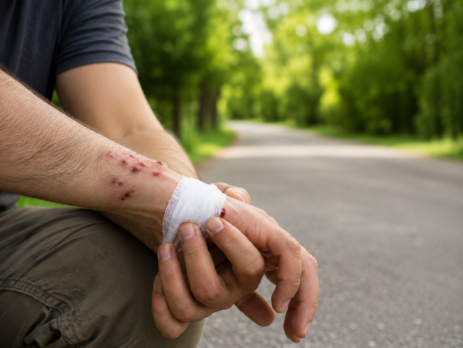
If there is active bleeding, apply a clean bandage or sterile compress to the wound and apply pressure. Do not waste time on home “folk” remedies, harsh chemicals, or delaying treatment in the hope that “it will go away.” Bites may look small on the outside but can be deep, contaminated, and carry a high risk of infection. The NHS explicitly states that some animal bites require medical attention even when they do not appear serious at first glance.
When Medical Care Cannot Be Delayed
There are situations in which a person should not hesitate at all. These include heavy bleeding, deep or lacerated wounds, bites to the face, hands, feet, the neck, joints, tendons, or genital area, as well as cases involving severe pain, loss of sensation, difficulty moving, or visible tissue damage. The risk is also higher for people with weakened immune systems, chronic illnesses, or problems with wound healing.
Tetanus and rabies should also be considered. The CDC notes that tetanus prevention depends on the type of wound and vaccination history. For rabies, the assessment depends on the animal, its behavior, the local risk, and the circumstances surrounding the incident. The WHO emphasizes that, when at risk, timely post-exposure prophylaxis saves lives. In the case of a dog bite, seeking medical advice is not an unnecessary precaution but is often a mandatory part of proper response.
What Signs of Infection to Watch For
Even if the wound seems small at first, monitor it over the next few hours and days. Warning signs include increasing redness, warmth, swelling, pus, worsening pain, fever, chills, or general malaise. The NHS and other clinical sources warn that animal bites can become infected relatively easily, especially if they are deep or dirty.
This is why prevention is so important. When you carry a dog repellent and manage to defuse the situation before contact occurs, you not only avoid the pain and stress of the actual dog bite, but also all the subsequent risks-wound care, infection, vaccination assessment, medical expenses, and psychological stress.
Who the Dog Repellent Is Ideal For
There are certain groups of people for whom this device has even greater practical value. These include runners, cyclists, hikers, hunters, anglers, delivery drivers, field workers, night shift workers, security guards, and anyone who regularly passes through areas with stray dogs or near yards with aggressive guard dogs. For them, the risk isn’t abstract-it’s a recurring one. A working dog repellent in your pocket is often more useful than the hope that “I won’t run into a problem today.”
It’s also suitable for people who simply want greater peace of mind while out walking. It’s not about fear, but about sensible preparation. Just as one carries a flashlight, a first-aid kit, water, or an umbrella, one can also carry a means of keeping a safe distance in case of an aggressive dog.
Why This Topic Is About Prevention, Not Just First Aid
The medical response after an incident is important, but it comes after the problem has already occurred. A more useful strategy is to think about how to avoid being bitten by a dog in the first place. This involves vigilance, keeping a safe distance, proper behavior, and having a dog repellent as a specific tool.
When this logic is adopted in time, a person changes the way they move through high-risk areas. They scan their surroundings more carefully, do not underestimate groups of dogs, do not enter a conflict zone with abrupt behavior, and do not rely on luck every time. This is not paranoia, but a culture of safety.
The issue of dog bites should not be viewed merely as an accidental injury. It is a situation that carries the risk of pain, infection, medical intervention, immunization assessment, and lasting stress. That is precisely why prevention is the most sensible approach. Staying calm, avoiding running and direct eye contact, being aware of your surroundings, and quickly backing away are all important. But when the risk is real and recurring, a dog repellent deserves a permanent place in your personal gear.
The dog repellent’s greatest strength is that it works before contact is made. It can stop an attacker from approaching, create distance, and help you retreat before the situation escalates into a physical attack. So, if you’re looking for a practical takeaway from this topic, here it is: don’t wait until you’ve been bitten by a dog to think about self-defense. Be prepared in advance, keep a dog repellent within easy reach, and treat prevention as the strongest form of personal safety.