The Best Hunting Carbine
The best hunting rifle is not a universal concept. It all depends on the conditions in which you hunt: terrain, distance, game, season, personal habits, and experience. Choosing a hunting rifle rarely comes down to a single brand, a single caliber, or a specific model. One hunter looks for a lightweight rifle for long treks through rugged terrain, another prioritizes stability when shooting from a blind, and a third values versatility because they participate in various hunting trips throughout the year.
That’s exactly why a successful choice doesn’t start with an advertising message, but with a clear assessment of what you actually need. A good rifle isn’t the one that looks impressive in a photo, but the one that fits comfortably in your hands, performs reliably, balances well with your chosen scope, and instills confidence on every outing. When a rifle is chosen wisely, it doesn’t just make aiming easier-it becomes an extension of the hunter. In this article, we’ll examine which factors carry the most weight in the selection process, which compromises are acceptable, which mistakes are most commonly made, and how to determine which model makes sense for your goals. So instead of searching for an abstract “top model,” you’ll arrive at a decision that delivers real value in the field.
Why There Is No Universal Answer to Which Is the Best Hunting Rifle
The term “best” sounds definitive, but in hunting practice it is almost always relative. A rifle which is excellent for hunting in the woods, won’t be the first choice for a long, precise shot in open terrain. The same applies in reverse: a heavy model with a long barrel and a stable platform may be great for a stalking hunt, but it can be exhausting during prolonged movement in mountainous terrain.
Hunters have different levels of experience, physical builds, and habits. One prefers a classic wooden stock and the feel of tradition. Another insists on synthetic materials that withstand moisture, cold, and rough handling. A third prioritizes the action’s performance and smooth reloading. A fourth makes no compromises on weight, because he spends hours on the move. That’s why the right choice comes from the right balance between intended use, ergonomics, reliability, and budget. When these four elements are in balance, your chances of finding the right carbine increase significantly.
How to Determine Which Hunting Rifle Is Best for You
When looking for the best hunting rifle, first ask yourself a few basic questions. They’ll narrow down your choices faster and more accurately than any ranking.
1. What type of hunting do you do most often
The type of hunting is the starting point. If you mainly hunt from a blind, it usually makes sense to look for more stable setups that work well with high-quality optics and provide confidence when shooting atlonger distances. If stalking is your main activity, the key factors are quick weapon raise, good balance, and ease of use in dense terrain. For transitional hunting or combined outings, versatility takes center stage.
2. What kind of terrain do you hunt in?
Forests, hilly areas, open fields, and mountains each present different challenges. In dense vegetation, a more compact profile is an advantage. In open terrain, stability and accuracy at a distance are more important. In the mountains, every extra gram is distinctly felt after a few hours of movement. This is precisely where it becomes clear how important it is for a firearm to be suited to the actual environment, rather than to general recommendations.
3. At what ranges do you shoot
There’s no point in choosing a configuration geared toward long-range shots if your typical shooting situations are at short to medium ranges. Similarly, a light and short platform isn’t always optimal when you’re looking for maximum stability at longer ranges. Accurately assessing the distance will also guide you in choosing the caliber, barrel length, and scope mount.
4. What Type of Game Is Your Main Focus?
The size and characteristics of the game also play a key role. For small and medium-sized game, a more controllable recoil and good accuracy are often sought. For larger game, energy, a confident hit, and proper ammunition performance take center stage. There is no universal caliber that is equally suitable for every task without compromise.
5. How Does the Gun Feel in Your Hands
This is a factor that is often underestimated. The balance, stock length, stock shape, grip, and smoothness of the action are elements that are immediately noticeable. A carbine with excellent specs on paper may not be the right fit for a particular hunter. A model that sits comfortably on the shoulder and provides control from the very first moment often turns out to be the better choice.
Bolt-Action or Semi-Automatic Rifle
One of the classic dilemmas is the type of action. Bolt-action rifles are valued for their structural simplicity, reliability, and excellent potential for accuracy. They are often the preferred choice for hunters who value precision, consistency, and clean mechanics without unnecessary complexity. Maintenance is easier with them, and the market offers a wide variety of models, configurations, and calibers.
Semi-automatic platforms have their own strengths, related to dynamics and the speed of follow-up shots. For some hunters, this offers an advantage in certain situations, but the system is more specialized, and the choice must be carefully considered based on intended use, personal preferences, and applicable regulatory framework. For a significant number of hunters, the bolt-action system remains the most balanced solution. It offers control, reliability, and a wide selection across various price ranges. It is therefore no coincidence that when discussing the best hunting carbine, the conversation often begins with a high-quality bolt-action model.
Features of the Best Hunting Rifle
Weight and Balance
A lightweight carbine is comfortable for hiking, but if it’s too light, it can affect the feel of the shot and overall stability. A heavier model is more stable, but puts more strain on you when carrying it. The best solution is usually a middle ground: a weight that doesn’t tire you out unnecessarily, but still provides control.
Barrel Length
A shorter barrel is convenient in dense terrain and for quick shooting. A longer barrel offers advantages for certain calibers and configurations, especially when seeking better performance at long range. There is no hard-and-fast rule here, that applies to everyone. The important thing is that there be a logical relationship between the barrel length, the chosen caliber, and the hunting method.
Stock Material
Wood offers a classic look, an attractive appearance, and a pleasant feel. A synthetic stock provides resistance to moisture, temperature changes, and rougher use. For hunters who venture out in harsh conditions, the synthetic option is often more practical. For fans of traditional style, well-selected wood remains a strong choice.
Trigger
A high-quality trigger has a direct impact on control and consistency. A trigger that is too heavy can impair firing performance, while a trigger that is too light isn’t suitable for every hunter or every situation. It’s important for the trigger to be crisp, predictable, and instill confidence.
Mechanical Reliability
Smooth bolt operation, build quality, reliable feeding from the magazine, and durability in the field are not mere details-they are the foundation. A hunting rifle must perform without hesitation when the situation demands it. Compromises are rarely a good idea here.
The Most Popular Calibers for General Hunting
Caliber is a topic that sparks lengthy debates, but a few options stand out as proven and practical for a wide range of hunters.
.308 Winchester is among the most sought-after options due to its good balance between manageable recoil, ammunition availability, and versatility. It is suitable for hunters looking for a practical solution with a wide range of applications.
.30-06 Springfield is a classic with a long history and a wide range of applications. It offers flexibility and is preferred by hunters who want a versatile caliber with a proven track record.
The 6.5 Creedmoor has firmly established itself among shooters who value good ballistics and confidence at longer ranges. It is suitable for those seeking a modern feel and precision.
.The .243 Winchester is a good choice for some hunters who prefer lighter recoil and good accuracy in certain scenarios and for specific game species.
The truth is that caliber should not be chosen in isolation. It works in conjunction with the barrel, the scope, the distance, the shooter’s experience, and the primary type of hunting. A well-chosen caliber makes the riflemore effective. An unsuitable caliber can leave you feeling like you’ve had to compromise, even when the model itself is high-quality.
Optics Are Not a Secondary Component for the Best Hunting Carbine
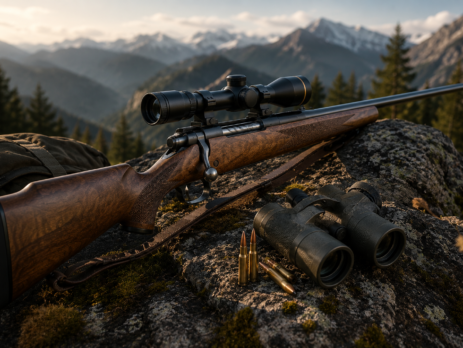
Often, nearly 100% of the budget goes toward the rifle itself, while the optics take a back seat. This is a mistake. Even an excellent rifle won’t reach its full potential if paired with poor optics or a subpar mount. A clear image, reliable adjustment mechanisms, good low-light performance, and a sturdy mount are crucial to the entire system.
The approach must be balanced: the rifle, scope, and mount should all be of comparable quality. When one of these components falls short, the overall performance suffers. For a hunter looking to make a wise investment, this is a fundamental principle.
Common Mistakes When Choosing
Buying Based on Others’ Opinions Without Personal Testing
What works for one hunter isn’t necessarily right for another. Body types, habits, and hunting styles vary. It’s good to seek advice, but the final decision must be personal and well-reasoned.
Excessive Focus on the Brand
A strong brand name matters, but it’s not enough on its own. There are models from various manufacturers that offer excellent value in their class. It makes more sense to look at the specific model rather than just the logo on it.
Underestimating Ergonomics
Some hunters focus on spec sheets and technical data, but overlook the most important aspect: how the gun feels against the shoulder, how it is raised, how it is reloaded, and how intuitive its handling is. In the field, you can feel this right away.
Choosing Without Thinking About Future Configuration
The carabiner rarely remains in its very basic form. Optics, a mount, a sling, and sometimes a bipod or other accessories are added depending on its intended use. That’s why it’s best to think systematically from the very beginning, rather than just focusing on the bare weapon.
Exceeding the Actual Budget
It’s better to choose a balanced configuration within your means than an expensive model with subpar optics and hastily chosen accessories. A smart purchase isn’t the one with the highest price, but the one with the best balance of quality, purpose, and long-term value.
How to Identify the Right Model of the Best Hunting Carbine
When looking at different rifles, don’t be guided solely by their appearance. Pay attention to several features:
- how the bolt operates and whether its movement is smooth;
- how the trigger feels;
- how comfortably the stock rests against the shoulder;
- what is the balance between the front and rear;
- is the handling intuitive;
- Does it have a good mount for optics?
- what is the overall impression of the build quality.
Here, consulting with a specialist is extremely valuable. An experienced dealer can guide you toward suitable configurations based on your hunting style, rather than recommending a model simply because it’s popular. This is especially important if you’re buying your first carbine or switching platforms after long-term use of another type of firearm.
Which Air Rifle Is Best Suited to the Hunter’s Profile
A hunter looking for the best hunting rifle for general-purpose use usually benefits from a bolt-action model in a proven, versatile caliber, with moderate weight, a reliable synthetic or high-quality wooden stock, and a good mount for optics. This is a configuration that covers a wide range of situations and provides a good starting point.
A hunter who spends long hours on the move and values lightness will likely prefer a more compact and lightweight platform with a comfortable balance. For them, every extra gram counts. A hunter who primarily hunts from a blind and operates at longer ranges will more often value stability, a smoother recoil, and well-integrated optics. A hunter with a taste for classic style may choose a rifle with a wooden stock and a traditional look, as long as this does not conflict with their practical needs. A hunter who ventures out in harsh conditions will likely focus on durable materials and easy maintenance. There is no one-size-fits-all solution, but there is a logic to it: the right carbine is the one that meets your needs without unnecessary compromises.
The answer to the question of which is the best hunting rifle cannot be found in a single ranking. It lies in a well-considered choice tailored to your hunting style, shooting distances, terrain, game, how it feels in your hands, and your budget for the entire system. The most sensible approach is to look not for the “most hyped” model, but for the one that offers reliability, control, comfort, and confidence in real-world use.
A good hunting rifle should fit you, perform predictably, and support your hunting style, rather than forcing you to adapt to it. When the choice is made correctly, you get not just a firearm, but a long-term partner for your future hunting trips. For a store like arms.bg, the real value in this area lies precisely in expert guidance. Hunters aren’t just looking for a product. They’re looking for certainty, meaningful advice, and a solution that will serve them well for a long time. That’s why the best article on this topic doesn’t promise miracles-it helps the reader make an informed choice. And that’s exactly when the content works for both the user and search engines.