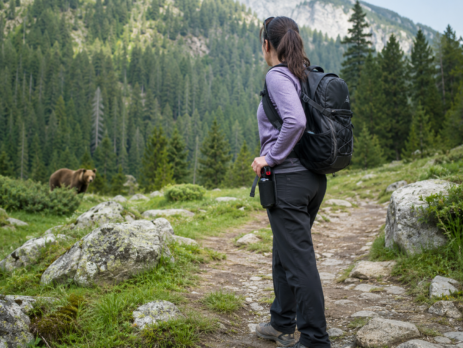
Bear Spray and Peace of Mind in the Mountains: How Bulgaria Seeks a Balance Between Public Safety and Bear Conservation
Incidents involving bears near populated areas and tourist routes have once again brought the issue of safety in the Bulgarian mountains to the forefront. Following the incident on Vitosha in May 2026, authorities conducted patrols, set up camera traps, carried out drone surveillance, and increased police presence in the area; according to expert data, there is a population of about 18-20 brown bears in Vitosha, Plana and Verila are home to a population of about 18-20 brown bears. However, the issue should not be reduced to a fear of wild animals. The bear is not an “enemy” of humans, but a protected species whose behavior is often linked to human pressure, lack of food, poor waste management, and humans encroaching ever deeper into its habitats.
That is why the discussion about bear spray must be placed in the proper context. It is not a means of aggression, it is not a reason for people to take unnecessary risks, and it is not a substitute for sensible behavior in the mountains. It is a last-resort, defensive measure in the event of a dangerous close encounter with an aggressive animal. The correct approach is a combination of awareness, prevention, respect for nature, and readiness to react.
What the Institutions Say
The position of the Ministry of Environment and Water is that the brown bear is a species with the highest level of protection under Bulgarian and European legislation. The Ministry emphasizes that management of the species must be based on accurate data, not on rumors or exaggerations. In the Central Stara Planina Mountains, for example, data over the years show the presence of bears, but the ministry clarifies that monitoring tracks trends rather than merely “counting” individual animals.
An important step is the recently launched project for DNA monitoring of the brown bear-the first of its kind in Bulgaria. Samples are collected from across the species’ entire range and sent for analysis to a laboratory in Slovenia; the results are expected to support more effective population management. This is crucial because the public debate often swings between two extremes: one side claims there are “too many” bears, while the other insists there is no problem at all. An expert approach requires accurate data.
The government has also introduced a new protocol for responding to bears entering populated areas. It provides for coordination between forestry agencies, the Ministry of the Interior, and experts from the Ministry of Environment and Water, including notifying residents, patrolling the area, safety instructions, driving away a problematic individual, or monitoring the area for up to 72 hours if the animal has retreated. The goal is to ensure the safety of citizens without endangering the lives of the animals.
Conservationists’ Perspective on Bears
WWF Bulgaria views human-bear conflict as a problem that is not solved by hatred toward animals, but through prevention. The organization points out that negative human influence can cause bears to alter their territorial range. When an animal loses its fear of humans and begins to search for food near populated areas, the risk of conflict increases, as does the risk of illegal hunting.
According to WWF, bears are not only part of nature but also part of our history and culture. That is why the organization works with local communities, farmers, and institutions to secure apiaries, barns, and orchards, to ensure proper household waste management, and to conduct awareness campaigns. Practical measures include electric fences, informational signs, training, and responding to reports. In 2023 alone, WWF’s Bear Rescue Team received and responded to nearly 70 reports related to bear damage or bears entering populated areas.
Alexander Dutsov, Senior Species Conservation Expert at WWF, clearly articulates the problem: bears do not venture into human settlements because they want to attack, but because they are forced to do so by the disrupted ecosystem in which they live. This is a sign of how human management of nature affects safety in populated areas.
What is the role of bear spray
In international practice, bear spray is considered a non-lethal means of protection against the risk of an attack. The Interagency Grizzly Bear Committee recommends that people who work or travel in bear habitats carry bear spray in an easily accessible place and know how to use it. The Committee emphasizes that carrying bear spray does not replace the basic rules for avoiding encounters with bears.
This distinction is important. Bear spray should not be sprayed on clothing, tents, backpacks, or around a campsite “as a preventative measure.” It is an airborne deterrent cloud that is used only when a bear is aggressive or attacking. Pre-sprayed items may even attract wildlife.
A study of bear spray incidents in Alaska, cited by the IGBC, shows that the spray deterred unwanted bear behavior in over 90% of cases, and in 72 incidents involving 175 people, only three were injured, and none seriously. This does not mean there is a 100% guarantee. It means that when carried properly, kept within easy reach, and used with proper training, the spray can be an important part of personal safety-especially for tourists, hunters, forest rangers, shepherds, photographers, and people who regularly travel through areas with bear activity.
How to Behave in the Mountains
The best defense is still to avoid unexpected encounters. WWF’s advice for Bulgaria includes traveling in groups, making moderate noise in areas with bears, avoiding headphones, packing out food and trash, and refraining from behavior that attracts animals. In areas permanently inhabited by bears, such as Rila, Pirin, Vitosha, the Western Rhodopes, and the Central Stara Planina, it is important for tourists to be cautious.
If you see a bear, do not approach it or try to take a close-up photo. Do not run, as this may provoke a chase. Back away slowly without turning your back. If the bear stands on its hind legs, this is often an attempt to gather more information through smell and hearing, and not necessarily a sign of an attack.
It is dangerous to stand between a mother bear and her cub. If you see a cub on its own, do not approach it-the mother is almost always nearby. If you encounter an injured bear, a dead bear, or a bear in a populated area, the correct response is to call 112 or contact the appropriate authorities, not to intervene on your own.
Balance, Not Panic
The issue of bears in Bulgaria will remain a pressing concern. Climate change, disrupted wildlife corridors, abandoned properties, unregulated landfills, and increased tourism are raising the likelihood that people and bears will encounter each other more frequently. The answer is not to demonize the animal, but to improve organization: accurate monitoring, prevention measures around farms, clean communities, clear protocols, informed tourists, and timely alerts.
Bear spray has a place as a sensible means of self-defense, but only when it is part of a broader culture of safety. Carrying it must be accompanied by training, checking the expiration date, easy access to the canister, and a clear understanding that it is a last resort, not an invitation to take risks.
Bears do not seek conflict with humans. They often try to avoid encounters. Our task is to avoid attracting them, to avoid provoking them, and to avoid turning every incident into a cause for fear and hatred. Bulgaria’s natural environment is rich precisely because it is still home to large wild animals. True safety comes not from waging war against them, but from knowledge, respect, and preparedness.